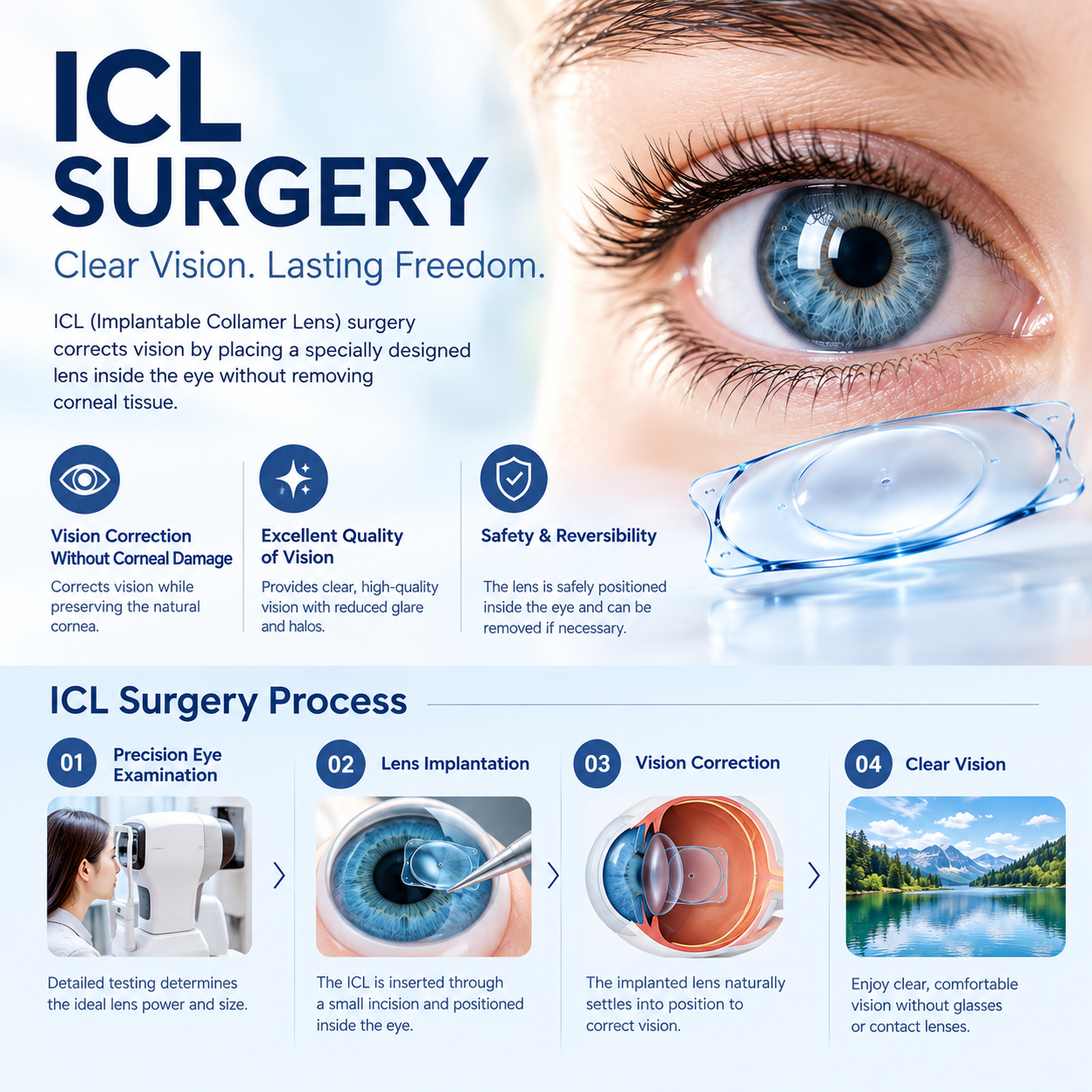
ICL Patient Reviews in Gangnam, Seoul
at B&VIIT Eye Center Gangnam
ICL patient reviews often describe the consultation process, comfort during surgery, speed of visual recovery, night-vision changes, and postoperative care. Many patients explore ICL because of high myopia, thin corneas, dry-eye concerns, or limited eligibility for LASIK, LASEK, or SMILE. Reviews can provide useful personal perspectives, but individual experiences cannot predict another patient’s candidacy, safety, or final vision.
Why Do Patients Read ICL Surgery Reviews?
Patient reviews can help people understand what the ICL treatment journey may feel like beyond the clinical description of the procedure.
Prospective patients commonly look for information about:
- Thoroughness of the preoperative examination
- Clarity of the ophthalmologist’s explanation
- Comfort during ICL surgery
- Time required at the eye center
- Speed of visual improvement
- Glare or halos after surgery
- Early recovery and activity restrictions
- Quality of postoperative monitoring
- Communication with international patients
- Overall treatment value
Reviews are most useful when considered together with medical information and a comprehensive eye examination.
What Do Positive ICL Reviews Commonly Mention?
Positive ICL experiences may describe:
- Clearer distance vision
- Reduced dependence on glasses
- Greater freedom from contact lenses
- Rapid visual improvement
- Minimal discomfort during surgery
- Preservation of corneal tissue
- Supportive postoperative care
- Convenient examinations and follow-up
- Confidence during travel or daily activities
- Satisfaction among patients with high myopia
Results vary according to prescription, eye anatomy, lens selection, retinal health, and individual healing.
What Do Critical ICL Reviews Commonly Mention?
Not every patient has the same experience. Critical or mixed reviews may discuss:
- Glare or halos at night
- Temporary blurry vision
- Fluctuating visual clarity
- Dry or irritated eyes
- Light sensitivity
- Residual myopia or astigmatism
- Slower recovery than expected
- Anxiety about the procedure
- Unexpected medication or follow-up needs
- The need for lens repositioning or additional care
These experiences do not necessarily indicate that the procedure failed. However, persistent symptoms should be evaluated by an ophthalmologist.
ICL Reviews From High-Myopia Patients
Many people researching ICL have moderate or high myopia. They may have relied on thick glasses or strong contact lenses for years before considering surgery.
High-myopia patient reviews may focus on:
- The difference between corrected and uncorrected vision
- Adjustment after no longer wearing strong glasses
- Changes in image size or visual perception
- Night-driving experiences
- Retinal examinations before surgery
- Long-term follow-up recommendations
ICL corrects refractive error but does not eliminate the retinal risks associated with high myopia. Regular retinal examinations remain important.
ICL Reviews From Patients With Thin Corneas
Some patients consider ICL after learning that their corneas are too thin or unsuitable for the recommended level of laser correction.
These reviews may emphasize that ICL does not remove corneal tissue. However, thin corneas alone do not confirm eligibility. Patients still require detailed measurements of the internal eye structure, endothelial cells, eye pressure, natural lens, and retina.
ICL Reviews From Patients With Dry-Eye Concerns
Patients with contact-lens intolerance or existing dry-eye symptoms may research ICL as an alternative to corneal laser surgery.
Reviews may describe improvements associated with no longer wearing contact lenses. Temporary dryness or irritation can still occur after ICL because of the incision, postoperative medication, or pre-existing dry-eye disease.
Dry-eye symptoms should be assessed before surgery and managed according to the ophthalmologist’s recommendations.
What Do Patients Say About the ICL Consultation?
The consultation is an important part of the ICL experience because the procedure requires detailed measurements and customized lens selection.
Patient reviews may mention:
- The number of diagnostic tests
- Time required for the examination
- Pupil dilation
- Contact-lens discontinuation
- Explanation of ICL versus laser surgery
- Discussion of potential risks
- Selection of standard or toric ICL
- Lens power and size calculations
- Questions about recovery and travel
A thorough consultation should help the patient understand why ICL is or is not appropriate for their eyes.
What Do Patients Say About ICL Surgery Day?
Patients often describe ICL surgery as relatively quick, although the total appointment takes longer because of preparation and postoperative monitoring.
Surgery-day reviews may discuss:
- Anesthetic eye drops
- Bright lights during the procedure
- Mild pressure or unusual sensations
- Minimal pain
- Temporary blurry vision
- Light sensitivity
- Postoperative eye-pressure testing
- Instructions for eye drops
- Returning to the hotel after surgery
Patients should arrange transportation and avoid driving on the day of surgery.
Is ICL Surgery Painful According to Patient Experiences?
Many patients report minimal pain because anesthetic eye drops are used. Some describe pressure, watering, bright lights, or mild discomfort rather than sharp pain.
A gritty sensation or irritation may occur after surgery. Severe or increasing pain is not considered a routine recovery symptom and requires prompt medical evaluation.
What Do Reviews Say About Vision After ICL?
Many reviews describe noticeable vision improvement within the first day. Others report that their vision required more time to become clear and stable.
Early visual experiences may include:
- Clearer distance vision
- Temporary haze
- Fluctuating focus
- Glare or halos
- Light sensitivity
- Differences between the two eyes
- Gradual improvement over several days
Immediate clarity does not replace postoperative examinations. Eye pressure, inflammation, and lens position must still be checked.
What Do Patients Say About Glare and Halos?
Glare and halos are among the most commonly discussed issues in ICL reviews, particularly during night driving or when looking at bright lights.
Some patients report that these effects decrease as healing progresses and the brain adapts. Others may experience persistent symptoms requiring further evaluation.
Pupil size, prescription, lens position, residual refractive error, and other eye characteristics can influence night-vision quality.
What Do Reviews Say About ICL Recovery?
Recovery reviews vary. Some patients return to non-physical work relatively quickly, while others need more time because of light sensitivity, dryness, or fluctuating vision.
Patients may discuss:
- Using prescription eye drops
- Wearing protective eye shields
- Avoiding eye rubbing
- Delaying eye makeup
- Limiting screen time
- Avoiding swimming and saunas
- Waiting before strenuous exercise
- Attending multiple follow-up examinations
Recovery instructions should be based on the ophthalmologist’s assessment rather than another patient’s timeline.
ICL Reviews vs LASIK and SMILE Reviews
Patients often compare ICL reviews with experiences from LASIK, LASEK, or SMILE.
ICL reviews commonly emphasize:
- No removal of corneal tissue
- Suitability for some high prescriptions
- A physical lens implanted inside the eye
- Potential removability of the lens
- Intraocular surgical risks
- Need for long-term monitoring
Laser surgery reviews often focus on flap creation, surface healing, corneal reshaping, dryness, and recovery differences. The best procedure depends on the patient’s examination results.
EVO ICL Patient Reviews
EVO ICL features a central opening designed to support natural fluid circulation inside the eye. Reviews may discuss the consultation, lens implantation, visual recovery, glare, and postoperative monitoring.
Toric EVO ICL reviews may also mention astigmatism correction and lens alignment. Personal satisfaction does not confirm that EVO ICL is appropriate for every patient.
ICL Reviews From International Patients in Korea
International patients may evaluate both the medical treatment and the overall experience of receiving surgery abroad.
Reviews may discuss:
- Communication before arriving in Korea
- Appointment scheduling
- Directions to the eye center
- Language support
- Clarity of the cost estimate
- Length of the examination
- Surgery scheduling
- Accommodation near Gangnam
- Follow-up before flying home
- Access to medical records
Travel convenience is valuable, but the quality of examination, lens planning, surgery, and aftercare should remain the primary considerations.
Why Gangnam Is Convenient for ICL Patients
Gangnam offers convenient access to hotels, serviced residences, restaurants, pharmacies, taxis, and Seoul’s subway network.
Staying near B&VIIT Eye Center may make it easier to:
- Attend early postoperative appointments
- Return for additional eye-pressure checks
- Collect prescribed medication
- Rest after the procedure
- Avoid long journeys during early recovery
- Adjust travel plans when necessary
International patients should leave enough time in Seoul for all required follow-up visits.
How to Evaluate an ICL Patient Review
A reliable review usually includes specific information rather than only saying that the experience was good or bad.
Look for details about:
- The patient’s original prescription
- Whether standard or toric ICL was used
- Why the patient chose ICL
- Preoperative examination experience
- Surgery-day comfort
- Early side effects
- Recovery timeline
- Postoperative care
- Length of follow-up
- Whether the review was written soon after surgery or later
A review written one day after surgery provides different information from one written after several months or years.
Why ICL Reviews Can Be Different
Two patients treated with ICL can have different experiences because of differences in:
- Prescription strength
- Degree of astigmatism
- Pupil size
- Eye anatomy
- Lens type and size
- Retinal health
- Dry-eye condition
- Healing response
- Visual expectations
- Night-driving requirements
- Compliance with aftercare
A highly positive or negative review should not be treated as a guaranteed prediction of another person’s result.
Questions to Ask After Reading ICL Reviews
Patients can use reviews to prepare better consultation questions, such as:
- Am I a suitable ICL candidate?
- Do I need standard or toric ICL?
- What visual result is realistic for my prescription?
- What are my personal risk factors?
- How common are glare and halos?
- What happens if the lens rotates?
- How will my eye pressure be monitored?
- Could I still need glasses?
- How long should I remain in Seoul?
- What long-term examinations will I need?
These questions help turn general patient experiences into a more personalized medical discussion.
Can Patient Reviews Confirm ICL Safety?
No. Reviews cannot establish whether ICL is safe for an individual patient.
Safety requires comprehensive testing of:
- Prescription stability
- Corneal health
- Anterior chamber depth
- Endothelial cell count
- Eye pressure
- Natural lens condition
- Retinal health
- Internal eye anatomy
Patient reviews can supplement medical information, but they should never replace diagnostic testing or informed consent.
What Are the Risks Patients Should Understand?
Potential ICL risks include:
- Infection
- Inflammation
- Increased eye pressure
- Incorrect lens size or position
- Toric lens rotation
- Residual refractive error
- Endothelial cell loss
- Cataract formation
- Retinal complications
- Need for lens repositioning, exchange, or removal
Patients should receive an individualized explanation of risks before making a treatment decision.
Why Choose B&VIIT Eye Center Gangnam?
B&VIIT Eye Center Gangnam provides individualized ICL assessment, surgical planning, and postoperative monitoring for local and international patients.
The treatment process may include:
- Comprehensive ICL candidacy testing
- High-myopia and astigmatism evaluation
- Standard and toric ICL planning
- Personalized lens power and size calculations
- Comparison with LASIK, LASEK, and SMILE
- Eye-pressure and lens-position monitoring
- Recovery instructions
- International travel guidance
Book an ICL Consultation in Gangnam
Patient reviews can help you understand common questions and experiences, but your treatment plan must be based on your own eyes.
International patients can prepare their prescription history, contact-lens information, previous eye records, medical history, and preferred travel dates before contacting B&VIIT Eye Center Gangnam.
Frequently Asked Questions
Are ICL patient reviews reliable?
Reviews can provide useful personal perspectives, but they are subjective. They cannot predict another patient’s eligibility, visual outcome, or risk of complications.
What do positive ICL reviews usually mention?
Positive reviews may mention clearer vision, reduced dependence on glasses, rapid recovery, minimal surgical discomfort, and satisfaction with postoperative care.
What problems appear in negative ICL reviews?
Critical reviews may discuss glare, halos, fluctuating vision, dryness, residual prescription, slower recovery, or the need for additional treatment.
Do all ICL patients achieve perfect vision?
No. Results vary, and some patients may retain a small prescription or need glasses for specific tasks.
How soon do patients notice clearer vision?
Many notice improvement within the first day, but visual recovery and stabilization vary between patients.
Do ICL patients experience glare and halos?
Some patients experience glare or halos, especially during early recovery or at night. These symptoms may improve, but persistent problems require evaluation.
Can I choose ICL based on reviews alone?
No. The decision should be based on comprehensive eye testing, the ophthalmologist’s recommendation, and a clear understanding of the benefits and risks.
Can international patients share their ICL experience?
Yes. International patient feedback may help others understand the consultation, surgery, recovery, language support, and medical travel process in Seoul.