ICL Candidacy in Gangnam, Seoul
at B&VIIT Eye Center Gangnam
ICL surgery may be suitable for adults with myopia or astigmatism who want to reduce their dependence on glasses or contact lenses. It is often considered for patients with high prescriptions, thin corneas, dry-eye concerns, or limited eligibility for LASIK, LASEK, or SMILE. Final ICL candidacy can only be confirmed through detailed testing of the prescription, cornea, internal eye structure, retina, eye pressure, and overall eye health.
What Is ICL Surgery?
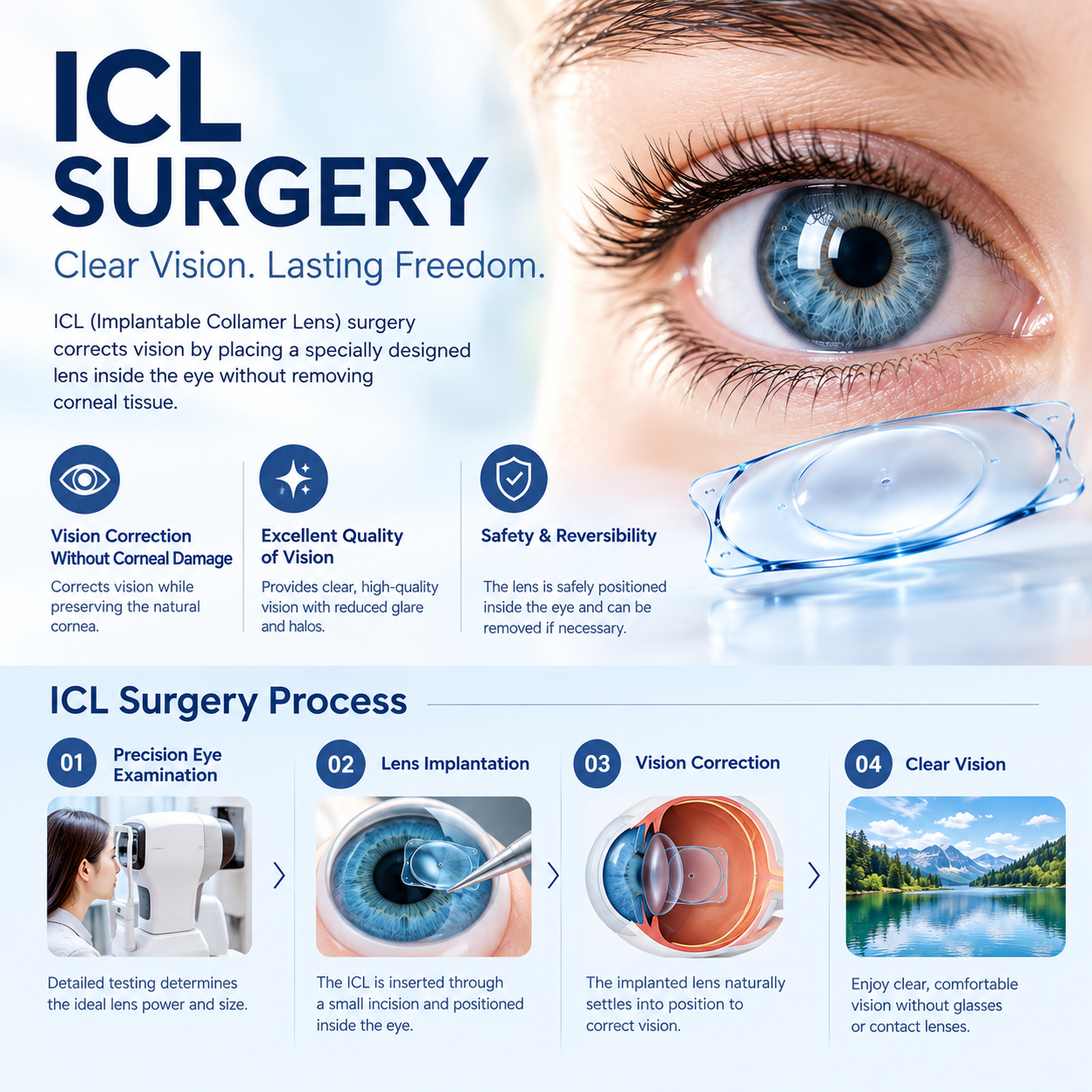
ICL stands for Implantable Collamer Lens. The procedure places a biocompatible corrective lens behind the iris and in front of the eye’s natural lens.
Unlike laser vision correction, ICL surgery does not remove or reshape corneal tissue. The natural lens also remains inside the eye.
ICL may therefore provide an alternative for eligible patients whose prescription or corneal condition makes laser eye surgery less appropriate.
Who Is a Good Candidate for ICL Surgery?
A suitable ICL candidate is generally an adult with a stable prescription and healthy eyes who wants surgical correction of myopia or myopic astigmatism.
Potential candidates may include patients who:
- Have moderate or high myopia
- Have myopia combined with astigmatism
- Have maintained a stable prescription
- Have sufficient internal eye space for safe lens placement
- Have an adequate corneal endothelial cell count
- Have healthy retinas and optic nerves
- Have thin corneas
- Experience contact-lens intolerance
- Have dry-eye concerns
- Are not ideal candidates for laser vision correction
- Understand the benefits, limitations, and risks of intraocular surgery
Meeting one or more of these conditions does not automatically confirm eligibility.
What Is the Recommended Age for ICL Surgery?
ICL is generally considered for adults whose eyes and prescriptions have stabilized. Younger patients with changing prescriptions may need to wait until their refractive error becomes stable.
Older patients require careful evaluation for presbyopia, early cataracts, glaucoma, retinal conditions, and other age-related eye changes.
Age alone does not determine candidacy. The ophthalmologist must consider the patient’s prescription, natural lens condition, eye anatomy, and long-term visual needs.
Does My Prescription Need to Be Stable?
A stable prescription is an important requirement for ICL surgery. Continued changes in myopia or astigmatism after lens implantation can produce residual refractive error and reduce the long-term accuracy of the correction.
Patients should provide previous prescriptions or eye examination records when available. The ophthalmologist will determine whether the prescription has remained sufficiently stable.
Can High-Myopia Patients Get ICL Surgery?
ICL is frequently considered for patients with moderate or high myopia, especially when their prescription exceeds the recommended range for corneal laser surgery.
However, high myopia may also be associated with retinal thinning, retinal tears, retinal detachment, or other changes inside the eye. A comprehensive retinal examination is therefore especially important.
A high prescription may make a patient interested in ICL, but it does not automatically make the patient eligible.
Can ICL Correct Astigmatism?
Toric ICL may correct myopia and astigmatism in eligible patients. The amount and stability of astigmatism must be measured during the preoperative examination.
Because a toric lens must remain at a specific angle, accurate calculations and lens positioning are essential. The ophthalmologist will determine whether toric ICL or another vision correction method is more appropriate.
Can Patients With Thin Corneas Get ICL?
Patients with thin corneas may be considered for ICL because the procedure does not use a laser to remove corneal tissue.
Corneal thickness is only one part of candidacy. Corneal shape, endothelial cell count, internal eye measurements, eye pressure, and retinal health must also be assessed.
Patients with certain corneal diseases or irregularities may require additional testing before a recommendation can be made.
Can Patients With Dry Eyes Get ICL?
ICL may be considered for patients with dry-eye concerns because it does not reshape the cornea. However, existing dry-eye disease should still be diagnosed and managed before surgery.
Temporary dryness or irritation may occur after the procedure because of the incision, postoperative medications, or changes in blinking.
Patients with severe or uncontrolled dry-eye disease may need treatment before their ICL eligibility is reconsidered.
Why Is Anterior Chamber Depth Important?
The anterior chamber is the internal space between the cornea and the iris. ICL surgery requires sufficient space for the lens to be placed safely behind the iris.
If the internal eye space is insufficient, the implanted lens could affect nearby structures or interfere with healthy fluid circulation.
B&VIIT Eye Center measures the internal dimensions of the eye to determine whether the anatomy is suitable for ICL implantation.
Why Is Endothelial Cell Count Important?
Endothelial cells help maintain corneal transparency by regulating fluid inside the cornea. These cells have a limited ability to regenerate.
Patients need an adequate endothelial cell density before ICL surgery. A low cell count may increase the risk of future corneal problems and may prevent a patient from qualifying.
The required cell density may vary according to age and individual eye characteristics.
Why Is Retinal Health Important?
Patients with high myopia can have an increased risk of retinal thinning, retinal tears, or retinal detachment. A dilated retinal examination may be performed before ICL surgery to identify these conditions.
Some retinal problems may require treatment or additional monitoring before vision correction surgery can proceed.
ICL corrects refractive error but does not eliminate the underlying retinal risks associated with high myopia.
Who May Not Be Suitable for ICL Surgery?
ICL may not be recommended for patients with:
- Unstable vision prescriptions
- Insufficient anterior chamber depth
- Low endothelial cell density
- Cataracts
- Uncontrolled glaucoma or abnormal eye pressure
- Active eye infection or inflammation
- Certain corneal diseases
- Significant retinal disease
- Severe uncontrolled dry-eye disease
- Unsuitable internal eye anatomy
- Unrealistic expectations about the outcome
- Medical or eye conditions that increase surgical risk
Pregnant or breastfeeding patients may be advised to postpone testing or surgery because hormonal changes can affect vision and eye measurements.
Can Patients With Cataracts Get ICL?
ICL is generally intended for patients whose natural lenses remain clear and healthy. If a cataract is present or likely to require treatment soon, another procedure involving replacement of the natural lens may be more appropriate.
The ophthalmologist will examine the natural lens and consider the patient’s age, visual symptoms, and long-term needs.
Can Patients With Glaucoma Get ICL?
Patients with glaucoma, ocular hypertension, narrow internal eye anatomy, or a history of abnormal eye pressure require careful evaluation.
ICL surgery may affect eye pressure and fluid circulation. Eligibility depends on the type and severity of the condition, current pressure control, optic nerve health, and internal eye measurements.
Can I Get ICL After LASIK or Another Eye Surgery?
Previous LASIK, LASEK, PRK, SMILE, retinal treatment, or other eye surgery does not always exclude ICL candidacy. However, it can affect surgical planning and risk assessment.
Patients should provide complete records of previous procedures whenever possible. Additional testing may be required before the ophthalmologist can recommend treatment.
ICL Candidacy Testing at B&VIIT Eye Center
B&VIIT Eye Center Gangnam performs comprehensive testing to determine whether ICL is appropriate for each patient.
The assessment may include:
- Visual acuity testing
- Current prescription measurement
- Cycloplegic refraction
- Corneal thickness measurement
- Corneal topography
- Anterior chamber depth measurement
- Endothelial cell count
- Eye-pressure testing
- Pupil size measurement
- Natural lens examination
- Dilated retinal examination
- Dry-eye assessment
- Astigmatism evaluation
- ICL power and size calculation
Additional examinations may be recommended according to the patient’s medical and eye history.
ICL vs LASIK, LASEK, and SMILE Candidacy
The best vision correction procedure depends on more than prescription strength.
LASIK, LASEK, and SMILE correct vision by reshaping the cornea. ICL places a corrective lens inside the eye without removing corneal tissue.
ICL may be considered when:
- The prescription is too high for the recommended laser correction
- The cornea is too thin for safe tissue removal
- Preserving corneal structure is a priority
- Dry-eye concerns make laser treatment less suitable
- The patient’s internal eye anatomy supports lens implantation
Because ICL is performed inside the eye, it also has specific risks and anatomical requirements that do not apply to corneal laser surgery.
How International Patients Can Check ICL Candidacy
International patients may begin by sending B&VIIT Eye Center:
- Their current glasses prescription
- Contact-lens prescription and type
- Previous eye examination results
- Corneal thickness results, if available
- History of eye surgery or disease
- Current medications
- Relevant medical conditions
- Preferred travel dates
These records may help with preliminary guidance, but they cannot replace an in-person comprehensive examination in Gangnam.
How Long Should International Patients Stay in Seoul?
International patients should allow enough time for:
- Contact-lens discontinuation when required
- Comprehensive ICL eligibility testing
- Lens selection and surgical planning
- ICL surgery
- Initial postoperative examinations
- Recovery monitoring
- Medical clearance before flying
The recommended stay depends on examination results, lens availability, treatment scheduling, and recovery.
Why Choose B&VIIT Eye Center Gangnam?
B&VIIT Eye Center in Gangnam provides comprehensive testing and individualized vision correction planning for local and international patients.
The ICL candidacy process may include:
- Detailed corneal and internal eye measurements
- High-myopia evaluation
- Toric ICL assessment for astigmatism
- Retinal examinations
- Endothelial cell testing
- Comparison with laser vision correction
- Personalized risk assessment
- Postoperative follow-up planning
- Travel guidance for international patients
Book an ICL Candidacy Examination in Gangnam
The only reliable way to determine ICL candidacy is through a comprehensive eye examination.
Patients visiting B&VIIT Eye Center Gangnam should prepare their prescription history, contact-lens information, previous surgical records, current medications, medical conditions, and preferred Seoul travel schedule.
The ophthalmologist will review the examination results and explain whether ICL, LASIK, LASEK, SMILE, or another option may be most appropriate.
Frequently Asked Questions
Am I a candidate for ICL surgery?
You may be a candidate if you have a stable myopic prescription, healthy eyes, adequate internal eye space, and sufficient endothelial cells. Comprehensive testing is required for confirmation.
Is ICL only for people with high myopia?
No. ICL may be considered for different levels of myopia when the patient’s prescription, anatomy, and eye health meet the relevant requirements.
Can I get ICL if my corneas are thin?
Possibly. ICL does not remove corneal tissue, but corneal health and the internal structure of the eye must still be carefully evaluated.
Can I get ICL if I have astigmatism?
Toric ICL may correct myopia with astigmatism in eligible patients. Detailed measurements are necessary to determine suitability.
Can I get ICL if I have dry eyes?
Patients with dry-eye concerns may be considered for ICL, but active or severe dry-eye disease may need treatment before surgery.
Does age affect ICL eligibility?
Yes. The prescription should be stable, and the natural lens should be healthy. Older patients also require evaluation for presbyopia, cataracts, and other age-related conditions.
Can ICL candidacy be confirmed online?
No. Records and prescriptions may support preliminary guidance, but final candidacy requires comprehensive in-person testing.
What happens if I am not eligible for ICL?
The ophthalmologist may discuss alternatives such as LASIK, LASEK, SMILE, glasses, contact lenses, or another treatment based on the examination results.