EVO ICL: Effects & Risks in Gangnam, Seoul
at B&VIIT Eye Center Gangnam
EVO ICL is an implantable vision correction lens used for eligible patients with myopia and, with a toric model, astigmatism. It can provide clear distance vision without removing corneal tissue or replacing the eye’s natural lens. Although many patients achieve significant vision improvement, EVO ICL is an intraocular procedure with potential side effects and risks that require careful screening and long-term monitoring.
What Is EVO ICL?
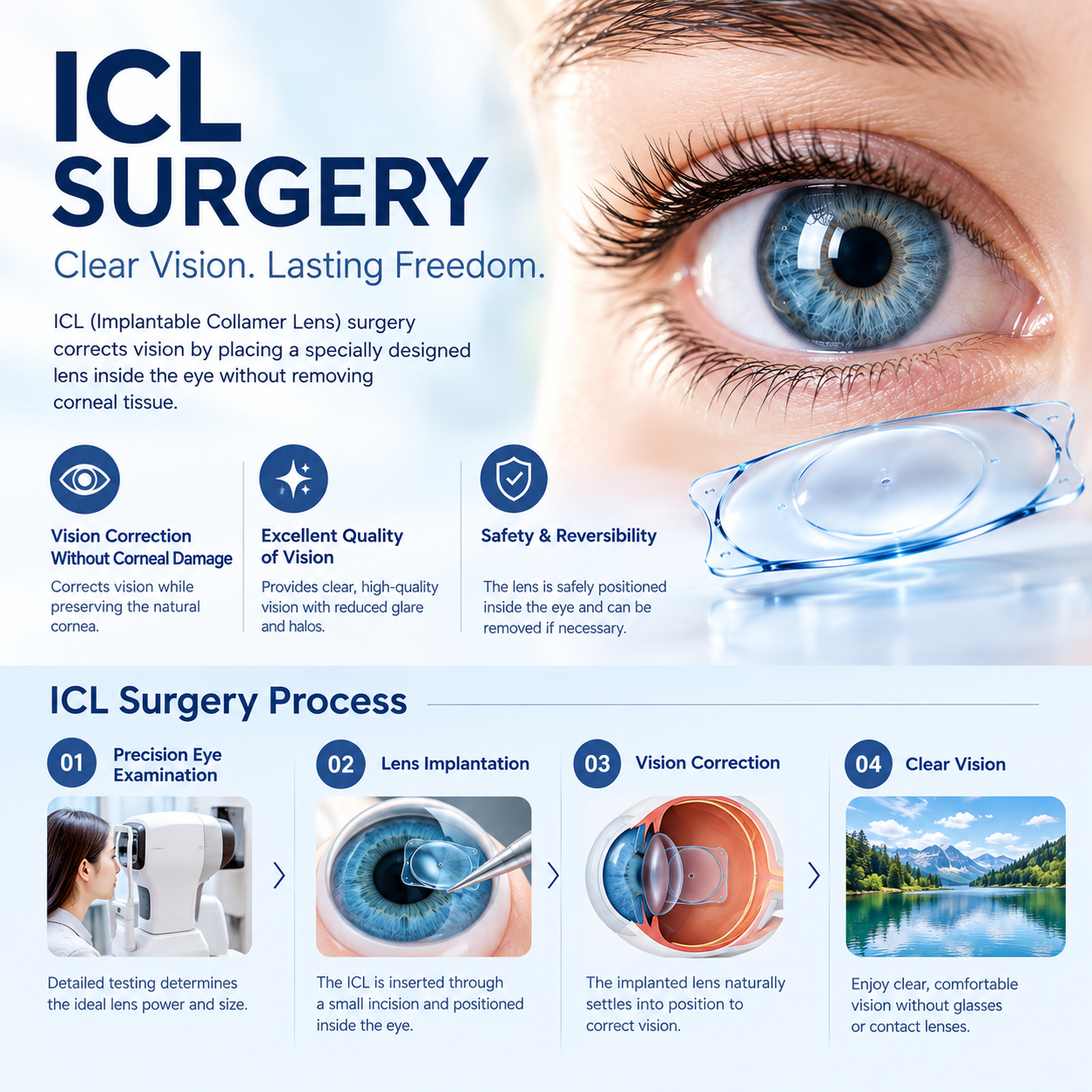
EVO ICL is a biocompatible implantable lens placed behind the iris and in front of the natural crystalline lens. It corrects vision by changing how light focuses inside the eye.
Unlike LASIK, LASEK, and SMILE, EVO ICL does not reshape the cornea. The lens also features a central opening designed to support the natural flow of fluid inside the eye.
EVO ICL may be considered for patients with moderate or high myopia, thin corneas, dry-eye concerns, or prescriptions that are less suitable for laser vision correction.
What Are the Effects of EVO ICL?
The primary effect of EVO ICL is clearer distance vision with reduced dependence on glasses or contact lenses.
Potential visual effects include:
- Correction of moderate or high myopia
- Astigmatism correction with toric EVO ICL
- Improved uncorrected distance vision
- Reduced dependence on glasses
- Reduced dependence on contact lenses
- Preservation of corneal tissue
- Rapid visual improvement for many patients
- Stable correction when the prescription remains stable
Individual outcomes depend on the prescription, eye anatomy, retinal health, lens selection, and healing response.
How Soon Does EVO ICL Improve Vision?
Many patients notice clearer vision within the first day after surgery. However, vision may initially fluctuate while the eyes heal and adjust to the implanted lenses.
Temporary early effects may include:
- Blurry or hazy vision
- Light sensitivity
- Glare
- Halos around lights
- Mild irritation
- Watery eyes
- Fluctuating visual clarity
Postoperative examinations are necessary to evaluate vision, eye pressure, inflammation, and lens position.
Does EVO ICL Provide Permanent Vision Correction?
EVO ICL is designed to remain inside the eye for long-term vision correction. However, it does not prevent natural changes caused by aging, eye disease, or changes in prescription.
Patients may still experience:
- Future changes in myopia or astigmatism
- Presbyopia and the need for reading glasses
- Cataract development with aging
- Retinal conditions associated with high myopia
- Other unrelated changes in eye health
EVO ICL can potentially be removed or replaced, but removal requires another intraocular surgical procedure.
Can EVO ICL Correct Astigmatism?
Toric EVO ICL may correct both myopia and astigmatism in eligible patients. Accurate measurement and positioning are particularly important because the toric lens must remain correctly aligned.
If the lens rotates away from its intended position, astigmatism correction may be reduced. Repositioning or another procedure may occasionally be required.
Does EVO ICL Cause Dry Eyes?
EVO ICL does not require corneal tissue removal or laser reshaping. For this reason, it may have a different dry-eye profile from corneal laser procedures.
Temporary dryness or irritation can still occur because of the incision, postoperative medication, reduced blinking, or pre-existing dry-eye disease. Patients should receive a dry-eye assessment and follow the prescribed aftercare plan.
What Are the Common Side Effects of EVO ICL?
Common short-term side effects may include:
- Blurry or fluctuating vision
- Glare and halos
- Light sensitivity
- Mild discomfort
- Dry or gritty eyes
- Watery eyes
- Temporary redness
- Difficulty with night vision
- Mild inflammation
These effects often improve as healing progresses, but the recovery experience varies. Persistent or worsening symptoms should be reported to the ophthalmologist.
What Are the Potential Risks of EVO ICL?
EVO ICL is an intraocular procedure and involves risks beyond those associated with glasses or contact lenses.
Potential complications may include:
- Infection inside the eye
- Inflammation
- Increased eye pressure
- Incorrect lens size or position
- Toric lens rotation
- Residual refractive error
- Glare, halos, or night-vision difficulties
- Reduced endothelial cell count
- Contact between the ICL and natural lens
- Cataract formation
- Retinal complications
- Need for lens repositioning, exchange, or removal
- Additional surgery
Serious complications are uncommon but can affect vision. Thorough preoperative testing and postoperative monitoring are essential.
Can EVO ICL Increase Eye Pressure?
Eye pressure may temporarily increase following EVO ICL surgery because of inflammation, retained surgical material, medication response, or changes in fluid circulation.
The central opening in the EVO ICL is designed to support natural fluid flow, but eye-pressure monitoring remains necessary. Patients must attend scheduled examinations even when their vision feels clear.
Can EVO ICL Cause Cataracts?
Cataract formation is a potential risk of implantable lens surgery. Risk may be influenced by the patient’s age, eye anatomy, lens position, distance between the ICL and natural lens, and other individual factors.
Careful lens sizing and long-term monitoring help the ophthalmologist evaluate the health of the natural lens.
Can EVO ICL Affect Corneal Endothelial Cells?
Endothelial cells help maintain corneal clarity. Because these cells have limited ability to regenerate, their number and condition must be evaluated before surgery.
B&VIIT Eye Center may measure the endothelial cell count during the eligibility examination and monitor it during future follow-up visits. Patients with insufficient endothelial cell density may not be suitable candidates.
Can EVO ICL Cause Glare or Halos?
Glare, halos, and light sensitivity may occur during early recovery. These symptoms can be more noticeable at night or around headlights and streetlights.
For many patients, they decrease as the eyes heal and the brain adapts. Persistent night-vision symptoms should be discussed with the ophthalmologist.
Can EVO ICL Be Removed?
The lens can potentially be removed, repositioned, or exchanged if medically necessary. This may be considered when there is incorrect sizing, rotation, a significant residual prescription, cataract development, or another complication.
However, removability does not make the procedure risk-free. Lens removal requires additional intraocular surgery and cannot guarantee that the eye will return to its exact preoperative condition.
Who May Have a Higher Risk of Complications?
EVO ICL may not be appropriate for every patient. Additional caution may be required for patients with:
- Insufficient anterior chamber depth
- Low endothelial cell density
- Uncontrolled eye pressure or glaucoma
- Cataracts
- Corneal disease
- Active eye inflammation or infection
- Unstable vision prescription
- Certain retinal conditions
- Severe uncontrolled dry-eye disease
- Eye anatomy unsuitable for safe lens placement
A high prescription alone does not confirm eligibility. Detailed examination of the entire eye is necessary.
How Does B&VIIT Eye Center Evaluate EVO ICL Safety?
Before recommending EVO ICL, B&VIIT Eye Center Gangnam performs diagnostic testing to assess the patient’s prescription, eye anatomy, and overall eye health.
The evaluation may include:
- Refraction and visual acuity testing
- Corneal topography and thickness measurement
- Anterior chamber depth measurement
- Endothelial cell examination
- Eye-pressure testing
- Pupil size assessment
- Retinal examination
- Dry-eye evaluation
- Natural lens assessment
- EVO ICL power and size calculation
- Astigmatism measurement
These results help the ophthalmologist determine whether EVO ICL, laser vision correction, or another option may be more suitable.
How Can EVO ICL Risks Be Reduced?
Risks cannot be eliminated completely, but careful screening and aftercare can help reduce avoidable complications.
Patients should:
- Provide complete medical and eye-health information
- Stop wearing contact lenses when instructed
- Follow all preoperative directions
- Use prescribed eye drops correctly
- Avoid rubbing or pressing the eyes
- Keep water and makeup away from the eyes initially
- Avoid strenuous exercise until approved
- Attend every postoperative examination
- Report unusual symptoms promptly
- Continue recommended long-term eye examinations
Warning Signs After EVO ICL Surgery
Patients should contact the eye center immediately if they experience:
- Severe or increasing eye pain
- Sudden loss or deterioration of vision
- Significant redness or swelling
- Persistent nausea accompanied by eye pain
- Unusual eye discharge
- Rapidly increasing light sensitivity
- New flashes or numerous floaters
- A curtain-like shadow in the visual field
Urgent symptoms should not be delayed until the next scheduled appointment.
EVO ICL for International Patients in Seoul
International patients considering EVO ICL in Gangnam should plan sufficient time for comprehensive testing, surgery, and postoperative monitoring.
Patients should confirm:
- Whether their prescription is within the treatable range
- Whether their eye anatomy is suitable
- Which EVO ICL model may be recommended
- How long the selected lens will take to prepare
- How many follow-up examinations are necessary
- When they may safely fly home
- How long-term monitoring will be arranged
B&VIIT Eye Center Gangnam can provide an individualized schedule after reviewing the patient’s examination results.
Why Choose B&VIIT Eye Center Gangnam?
B&VIIT Eye Center in Gangnam provides comprehensive assessment and individualized planning for patients considering EVO ICL in Seoul.
The treatment process may include:
- Detailed EVO ICL eligibility testing
- Personalized lens power and size calculations
- Toric EVO ICL assessment for astigmatism
- Comparison with LASIK, LASEK, and SMILE
- Individualized risk evaluation
- Postoperative eye-pressure checks
- Lens position monitoring
- Recovery and travel guidance for international patients
Book an EVO ICL Consultation in Gangnam
A comprehensive examination is the first step in determining whether the potential benefits of EVO ICL outweigh the risks for an individual patient.
International patients can prepare their current prescription, contact-lens history, previous eye examination records, medical history, and preferred travel dates before contacting B&VIIT Eye Center Gangnam.
Frequently Asked Questions
What is the main effect of EVO ICL?
EVO ICL corrects myopia by placing an implantable lens inside the eye. A toric version may also correct astigmatism in eligible patients.
Does EVO ICL guarantee perfect vision?
No. Results vary, and some patients may retain a residual prescription or require glasses for certain activities.
Is EVO ICL safer than LASIK?
The procedures use different methods and have different risk profiles. EVO ICL avoids corneal reshaping but involves surgery inside the eye. The safer option depends on the patient’s eye condition.
What are the most common EVO ICL side effects?
Temporary blurry vision, glare, halos, light sensitivity, dryness, and mild irritation may occur during early recovery.
What are the serious risks of EVO ICL?
Potential serious complications include infection, increased eye pressure, cataract formation, endothelial cell loss, retinal complications, and the need for additional surgery.
Can EVO ICL be removed if there is a problem?
The lens can potentially be removed, repositioned, or exchanged. However, another intraocular procedure is required.
Will I still need reading glasses after EVO ICL?
EVO ICL does not prevent presbyopia. Patients may require reading glasses as the natural lens changes with age.
Are long-term examinations necessary after EVO ICL?
- Yes. Regular eye examinations help monitor eye pressure, endothelial cells, the natural lens, retinal health, and EVO ICL position.