ICL Surgery FAQs in Gangnam, Seoul
at B&VIIT Eye Center Gangnam
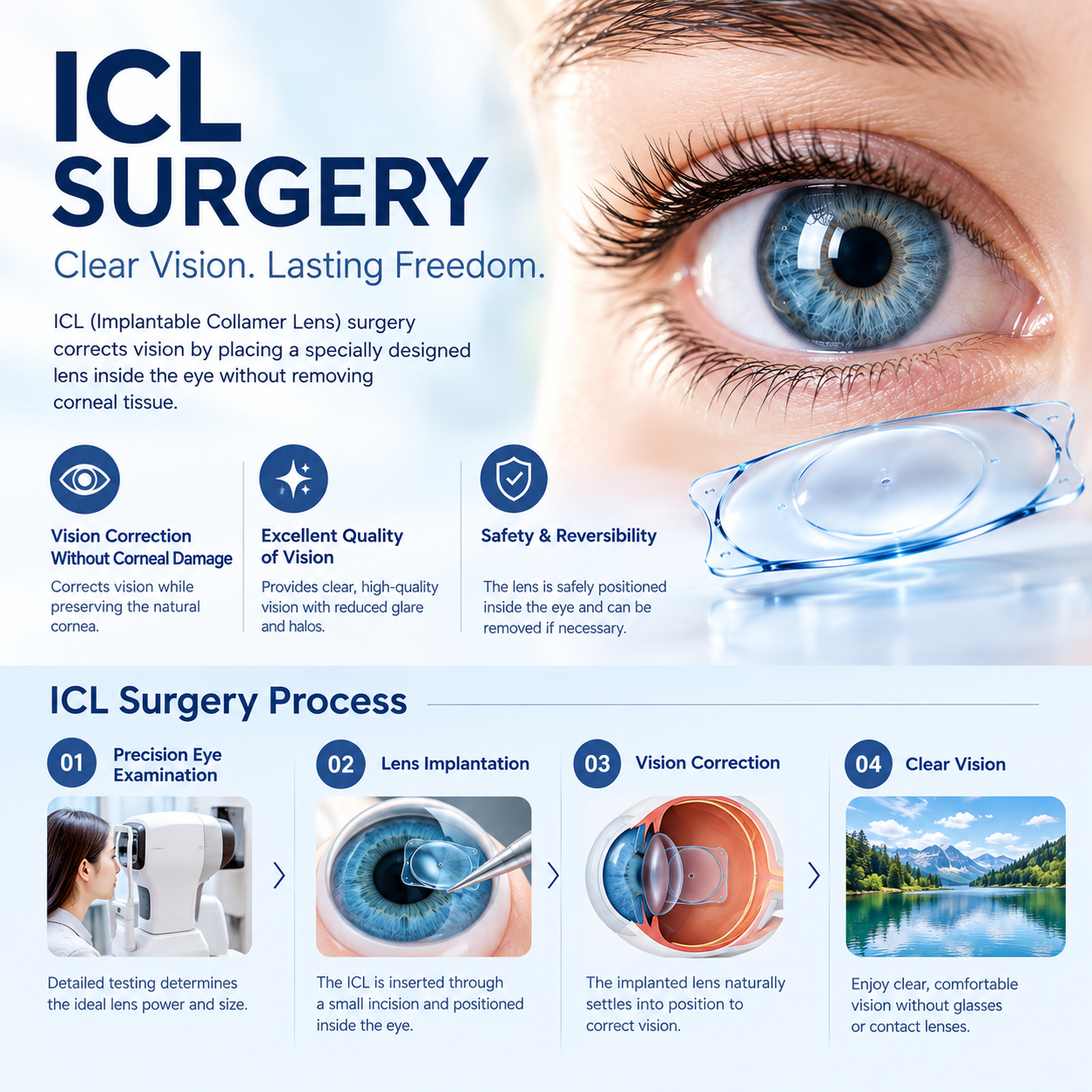
ICL surgery is an implantable vision correction procedure for eligible patients with myopia and astigmatism. Unlike LASIK, LASEK, or SMILE, ICL does not remove corneal tissue and leaves the eye’s natural lens in place. These frequently asked questions explain ICL candidacy, procedure time, potential benefits and risks, recovery, aftercare, and planning treatment in Seoul.
What Does ICL Mean?
ICL stands for Implantable Collamer Lens. It is a corrective lens placed inside the eye to improve refractive errors such as myopia.
The lens is positioned behind the iris and in front of the natural crystalline lens. It is generally not visible to other people after implantation.
How Does ICL Surgery Correct Vision?
ICL changes how light focuses inside the eye. The implanted lens works with the eye’s natural optical system to focus light more accurately on the retina.
Unlike laser eye surgery, it does not correct vision by removing or reshaping corneal tissue.
What Is EVO ICL?
EVO ICL is a type of implantable lens featuring a central opening designed to support the natural circulation of fluid inside the eye.
For appropriate patients, this design generally eliminates the need for a separate preoperative peripheral iridotomy. The ophthalmologist must confirm which lens model is suitable for each patient.
Who Is a Good Candidate for ICL Surgery?
Potential candidates generally have a stable myopic prescription, healthy eyes, adequate anterior chamber depth, and a sufficient corneal endothelial cell count.
ICL may be considered for patients who:
- Have moderate or high myopia
- Have myopia with astigmatism
- Have thin corneas
- Experience dry-eye concerns
- Are not ideal candidates for laser eye surgery
- Want to preserve their corneal tissue
- Have suitable internal eye anatomy
Final eligibility requires comprehensive in-person testing.
What Age Is Best for ICL Surgery?
ICL is generally considered for adults whose prescriptions have stabilized. Age-related changes such as presbyopia, cataracts, glaucoma, and retinal conditions must also be considered.
The appropriate treatment depends on eye health and long-term visual needs rather than age alone.
Does My Prescription Need to Be Stable?
Yes. A stable prescription helps improve the predictability and long-term accuracy of the correction.
Patients should bring previous prescriptions or examination records when possible. The ophthalmologist will determine whether the prescription has remained sufficiently stable.
Can ICL Correct High Myopia?
ICL is frequently considered for moderate and high myopia, including prescriptions that may be outside the preferred treatment range for laser vision correction.
High-myopia patients require careful retinal examinations because severe myopia can be associated with retinal thinning, retinal tears, or retinal detachment.
Can ICL Correct Astigmatism?
Toric ICL may correct both myopia and astigmatism in eligible patients. Accurate measurements are required to select the lens and determine its intended position.
Because toric correction depends on lens alignment, postoperative examinations are needed to confirm that the lens remains correctly positioned.
Can I Get ICL With Thin Corneas?
Possibly. ICL does not require laser removal of corneal tissue, so it may be considered for some patients with thin corneas.
However, corneal thickness is only one factor. Corneal shape, endothelial cells, internal eye measurements, eye pressure, and retinal health must also be evaluated.
Can I Get ICL If I Have Dry Eyes?
ICL may be considered for patients with dry-eye concerns because it does not involve extensive corneal reshaping.
However, dry-eye disease should still be assessed and treated when necessary. Temporary dryness or irritation can occur after the procedure.
How Is ICL Surgery Performed?
The ophthalmologist creates a small incision near the edge of the cornea. The folded ICL is inserted through the incision and positioned behind the iris and in front of the natural lens.
The surgeon then checks the lens position and, when using a toric lens, its rotational alignment.
Is the Natural Lens Removed?
No. ICL surgery does not remove the natural crystalline lens. The implantable lens is added inside the eye while the natural lens remains in place.
This differs from cataract surgery and refractive lens exchange, which remove and replace the natural lens.
Is Corneal Tissue Removed During ICL Surgery?
No. The cornea is not reshaped, and corneal tissue is not removed to correct the prescription.
A small incision is still required to insert the lens.
How Long Does ICL Surgery Take?
Lens implantation commonly takes approximately 10 to 20 minutes per eye. The exact time varies according to the patient’s eye anatomy, lens type, and surgical plan.
Additional time is required for preparation, pupil dilation, postoperative rest, eye-pressure testing, and discharge instructions.
Is ICL Surgery Painful?
Anesthetic eye drops are used to minimize discomfort. Patients may notice pressure, bright lights, watering, or unusual visual sensations during the procedure.
Mild irritation or a gritty sensation may occur during early recovery.
Are Stitches Required?
The incision used for ICL implantation is very small and often self-sealing. Stitches are generally unnecessary, although the surgeon will determine the appropriate approach for each eye.
Can Both Eyes Be Treated?
Many patients receive ICL correction in both eyes. Whether the procedures are completed according to a same-day or staged schedule depends on the eye center’s protocol and the patient’s individual condition.
How Soon Will My Vision Improve?
Many patients notice improved vision within the first day. Temporary blurriness, glare, halos, or fluctuating vision may occur while the eyes heal.
The rate of visual recovery varies between patients.
How Long Does ICL Recovery Take?
Initial recovery is often relatively quick, but complete healing and visual stabilization take longer.
Patients must attend postoperative examinations and wait for medical approval before resuming strenuous exercise, swimming, eye makeup, or contact sports.
When Can I Return to Work?
Some patients can return to non-physical work within a few days. The appropriate timing depends on visual comfort, the work environment, screen use, and the ophthalmologist’s recommendation.
Patients working in dusty environments or jobs with a risk of eye impact may require additional recovery time.
When Can I Drive?
Patients should not drive on the day of surgery. Driving may resume only after vision has been examined and the ophthalmologist confirms that it is safe.
Can I Use My Phone After ICL Surgery?
Short periods of phone or computer use may be possible if the eyes feel comfortable. Frequent breaks are recommended because prolonged screen use can increase dryness and eye fatigue.
Can I Shower After ICL Surgery?
Patients may be able to shower, but water, shampoo, and soap should be kept away from the eyes during early recovery.
The medical team will provide specific instructions for face and hair washing.
When Can I Wear Eye Makeup?
Eye makeup should be avoided during the initial healing period. Mascara, eyeliner, false eyelashes, and makeup applicators may irritate the eyes or introduce contamination.
Patients should wait until the ophthalmologist approves the use of eye-area cosmetics.
When Can I Exercise?
Light activity may resume relatively soon for many patients. Strenuous exercise, heavy lifting, swimming, saunas, and contact sports should be avoided until medically approved.
Do I Need Eye Drops After ICL Surgery?
Yes. Antibiotic and anti-inflammatory eye drops may be prescribed to support healing and reduce the risk of infection and inflammation.
Lubricating eye drops may also be recommended. Patients should use every medication according to the provided schedule.
What Are the Benefits of ICL Surgery?
Potential benefits include:
- Correction of moderate or high myopia
- Astigmatism correction with a toric lens
- Preservation of corneal tissue
- No removal of the natural lens
- Rapid visual improvement for many patients
- Reduced dependence on glasses or contact lenses
- Potential lens removal or replacement if medically necessary
Results vary, and perfect vision cannot be guaranteed.
What Are the Common Side Effects?
Temporary side effects may include:
- Blurry or fluctuating vision
- Glare and halos
- Light sensitivity
- Mild irritation
- Watery eyes
- Dry or gritty sensations
- Temporary redness
- Night-vision difficulties
Persistent or worsening symptoms should be reported to the eye center.
What Are the Risks of ICL Surgery?
Potential risks include:
- Infection
- Inflammation
- Increased eye pressure
- Incorrect lens size or position
- Toric lens rotation
- Residual refractive error
- Endothelial cell loss
- Cataract formation
- Retinal complications
- The need for lens repositioning, exchange, or removal
- Additional eye surgery
ICL is an intraocular procedure, so careful candidacy testing and follow-up are essential.
Can ICL Cause Cataracts?
Cataract formation is a possible risk. It may be related to age, eye anatomy, lens sizing, ICL position, or the distance between the ICL and the natural lens.
Long-term examinations help monitor the natural lens.
Can ICL Increase Eye Pressure?
Eye pressure may increase temporarily or, less commonly, remain elevated. Possible causes include inflammation, medication response, retained surgical material, or changes in fluid circulation.
Eye-pressure checks are an important part of postoperative care.
Can ICL Cause Glare or Halos?
Glare and halos can occur, particularly during early recovery or when driving at night. These effects may improve as the eyes heal and the brain adapts.
Persistent night-vision problems should be evaluated by the ophthalmologist.
Can the ICL Move or Rotate?
The lens is designed to remain in a stable position. However, an incorrectly sized lens may shift, and a toric ICL may occasionally rotate.
Significant movement or rotation may require lens repositioning or replacement.
Can ICL Be Removed?
The lens can potentially be removed or exchanged if medically necessary. However, this requires another intraocular procedure.
Removal does not guarantee that the eye will return to exactly the same condition it was in before implantation.
Is ICL Surgery Reversible?
ICL is often described as reversible because the lens can potentially be removed. A more accurate description is removable.
The procedure still involves an incision and surgery inside the eye, and not every effect of surgery can be guaranteed to reverse completely.
Does ICL Prevent My Prescription From Changing?
No. ICL corrects the existing refractive error but cannot prevent future changes in myopia, astigmatism, or eye health.
A stable prescription before surgery helps reduce the likelihood of significant residual refractive error.
Will I Need Reading Glasses After ICL?
ICL does not stop presbyopia, the natural age-related loss of near focusing ability. Patients may eventually need reading glasses even if their distance vision remains clear.
Does ICL Prevent Retinal Problems From High Myopia?
No. ICL corrects blurred vision caused by refractive error but does not eliminate the underlying retinal risks associated with high myopia.
Regular retinal examinations remain important after surgery.
Is ICL Better Than LASIK or SMILE?
No single procedure is best for every patient.
ICL may be preferred for some patients with high myopia, thin corneas, or dry-eye concerns. LASIK, LASEK, or SMILE may be more appropriate for patients who want corneal laser correction and meet the relevant safety requirements.
The recommendation should be based on comprehensive testing.
How Is ICL Different From Cataract Surgery?
ICL surgery preserves the natural lens and adds a corrective lens inside the eye.
Cataract surgery removes the cloudy natural lens and replaces it with an artificial intraocular lens. These procedures have different purposes and eligibility requirements.
How Much Does ICL Surgery Cost in Seoul?
The price can vary according to:
- Standard or toric ICL selection
- Prescription complexity
- Preoperative testing
- Surgeon and eye center
- Medication and follow-up inclusions
- Whether one or both eyes are treated
Patients should request an individualized quotation after their examination or preliminary records have been reviewed.
Does Insurance Cover ICL Surgery?
ICL for refractive correction is generally treated as an elective procedure and may not be covered by standard health insurance.
International patients should contact their insurer directly to confirm whether any examination or treatment costs are eligible for reimbursement.
How Long Should I Stay in Seoul for ICL Surgery?
International patients should allow time for:
- Comprehensive eligibility testing
- Lens selection and confirmation
- ICL surgery
- Early postoperative examinations
- Recovery monitoring
- Medical clearance before flying
The recommended stay depends on lens availability, scheduling, examination results, and recovery.
Can I Fly After ICL Surgery?
Flying may be possible after the ophthalmologist confirms that the eyes are stable. International patients should complete the required postoperative examinations before departing Korea.
Airplane cabins can be dry, so approved lubricating eye drops may be helpful during travel.
What Should I Bring to My ICL Consultation?
International patients should prepare:
- Current glasses prescription
- Contact-lens prescription and type
- Previous eye examination results
- History of eye surgery or disease
- Current medications
- Relevant medical information
- Preferred travel dates
- Questions about surgery and recovery
Previous records can support preliminary planning but cannot replace an in-person examination.
Why Choose B&VIIT Eye Center Gangnam?
B&VIIT Eye Center in Gangnam provides comprehensive vision correction examinations and personalized ICL planning for local and international patients.
The ICL process may include:
- Detailed candidacy testing
- High-myopia evaluation
- Corneal and internal eye measurements
- Endothelial cell testing
- Retinal examination
- Toric ICL assessment
- Comparison with LASIK, LASEK, and SMILE
- Postoperative monitoring
- International travel guidance
Book an ICL Consultation in Gangnam
Patients considering ICL surgery should begin with a comprehensive eye examination at B&VIIT Eye Center Gangnam.
- The examination determines whether the internal eye anatomy is suitable, which lens type may be needed, and whether ICL or another vision correction procedure may be more appropriate.